
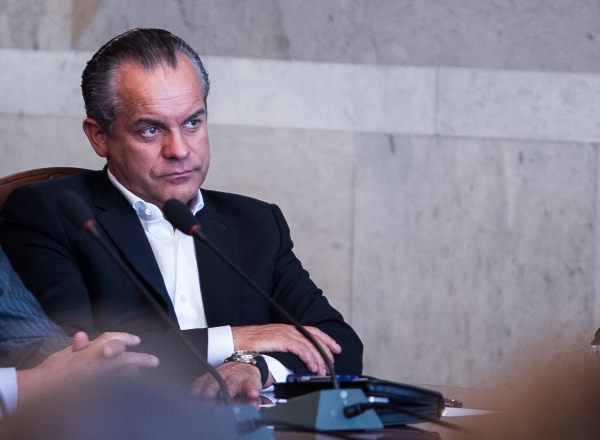
Potrivit sursei, fostul sef-adjunct al Sectiei Combatere a spalarii banilor din cadrul CNA Mihail Gofman in varsta de 43 de ani, fie este prost, fie este curajos, pentru ca si-a facut ca dusman, cel mai puternic oligarh din Moldova. Un oligarh suspectat de orchestrarea si devalizarea a trei banci si furtul a jumatate din rezerva Bancii Nationale a Moldovei, noteaza Forbes.com.
Forbes mai scrie ca, Vlad Plahotniuc a incasat peste 1 miliard de dolari din banca centrala a Moldovei si ca de fapt el a orchestrat spalarea de bani a creantelor oficiale.
"Intr-o recenta vizita la Washington, Gofman a incercat sa convinga autoritatile americane sa se implice, insa de multe ore s-au eschivat. Plahotniuc castiga si este nevinovat pana la proba contrarie ", scrie Forbes.
Jurnalistii de la Forbes mai spun ca un exemplu al puterii lui Plahotniuc este Veaceslav Platon pe care au incercat sa-l reduca la tacere.
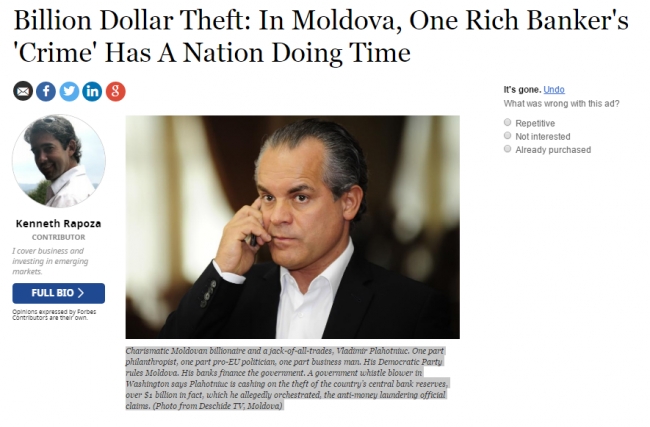
Articolul original:
Mihail Gofman is either a fool or as fearless as they come. The 43-year-old former deputy director of anti-money laundering and terrorist finance for Moldova has made enemies with his country’s most powerful billionaire – Vladimir Plahotniuc. The oligarch suspected of orchestrating the ransacking of three banks and the theft of half of the reserves of the National Bank of Moldova. And the locals are going to pay for it all, Gofman warns.
Interpol has had an investigation into Plahotniuc’s activities throughout Western Europe since 2007 and think he is loosely associated with one of Russia’s biggest mafias, the Solntsevskaya Brotherhood. On a recent trip to Washington, Gofman tried convincing the long arm of American justice to get involved, but time may be running out.
Plahotniuc is winning and the business leader is innocent until proven otherwise. But he is not the cleanest guy around. He was banned from running for Prime Minister by the Independence Party because of his spotty past. A July 26 arrest of a former associate in Ukraine who’s looking to sing like a canary to the Federal Bureau of Investigation is the most recent example of how whistle blowers against him get silenced.
See: How The Russians Helped Turn Moldova Into A Hot Bed For Money Laundering–Forbes
To put it simply, Plahotniuc is Moldova’s man behind the curtain, an A-list businessman who owns everything from luxury resorts to media outfits, and is vice chairman and chief financial backer of the ruling Democratic Party, which is nominally pro-Western. They’re the party of EU integration.
Through Plahotniuc and others within his circle, Gofman watched money jet in and out of Moldova like peak hours at Heathrow International. It found its way into Russia. Once ‘scrubbed clean’ into shell companies, it moved from off shore banks in Cyprus, via Moldova, to Latvia and further into Europe through banks like Société Général.
More than $1 billion was ransacked by a trio of the country’s most powerful and cunning oligarchs. At least half was laundered through three Russian banks, including Gazprombank, according to Moldovan prosecutors. To put that value into perspective, the country’s national GDP is around $8 billion. That would be like one man in the U.S. masterminding a plot to steal over $1 trillion from the financial system. If that’s not ballsy, what is? Ballsy might be an understatement when describing Plahotniuc and friends.
“Their ultimate scheme was to rob the central bank reserves of the country,” Gofman says in Russian, suited up with a white polka-dotted bow tie at Embassy Row hotel in Washington. Did they succeed at it? Yes, the Moldovan whistle blower says. They took over half of it.
Do you feel your life is in danger? Others down the ladder of importance have either mysteriously died or blown their heart out with a handgun. Gofman was fired from his job in April 2014. He smiles nervously. “You’re going to make me scared.”
Gofman came to Washington on July 10 for a weeklong stay and hasn’t been back to Moldova since. He met with an inter-agency group led by the U.S. Department of Homeland Security that combats international money laundering by political figures. As a matter of policy, the U.S. government neither confirms nor denies ongoing investigations.
One of Plahotniuc’s main sidekicks in banking is a person of interest, American passport holder Sergei Iralov. U.S. involvement in what is believed to have been an organized crime operation targeting Moldova’s public finances could lead to arrest warrants in the months ahead, particularly for Iralov, a Plahotniuc bestie, and possibly for Plahotniuc himself.
Moldova’s “Vampire Diaries”
The highway robbery of Moldova’s savings has led to two stunning ironies. One, the government wants to issue a bond to cover all the money taken by criminals from the National Bank coffers – with its complicity. The idea comes from the very Democratic Party that let the “crime of the century” happen on their watch, Gofman says.
Second, it opens the door for a pro-Russian politician now running for the presidency in the October general elections: Igor Dodon. As of April, Dodon was most popular candidate for the presidency, according to pollsters at the International Republican Institute in Moldova.
While in Washington, Gofman told me he hopes the International Monetary Fund will not throw money into Moldova, run by Prime Minister Pavel Filip of Plahotniuc’s Democratic Party. But hopes were dashed last week when the IMF agreed to a $175 million bailout package on July 26.
The IMF left the country only 9 months prior because of the theft of the central bank reserves. Corruption in the banking system is still rampant. The stolen funds have not been returned. But the IMF is back in anyway to plug up the holes. Despite Moldova per capita GDP being a whopping $2,000 a year, the lowest in Europe, saddling them with more debt appears to be the short-term solution even as there is a woeful lack of transparency as to what happened with the central bank’s vanishing cash.
Since the end of the Soviet Union, Moldova has been a hub for smuggling and contraband. But in 2009, with Plahotniuc’s party at the helm, it became a conduit of international money laundering.
“Gadafi money was funneled into European banks through Moldova,” says Gofman through a translator. His job was to know such things as the chief investigator at the National Anti-Corruption Center in Moldova, where he worked since 2004, and in forensic accounting for the government since 1997. He was a member of two Pan-European anti-money laundering committees known as Moneyval and the Egmont Group.
“The entire system was rigged by Plahotniuc, with Vlad Filat in his corner,” he says of the country’s former Prime Minister. Filat is serving a 9-year prison term for supposedly allowing National Bank reserves to be ransacked. The money was all funneled into three banks majority controlled by Plahotniuc – Sociala, Unibank and Banca de Economii (BEM), then the nation’s largest bank. The reserves went from $2.8 billion to $1.8 billion in less than three years.
Central bank governor Dorin Draghutanu stepped down in September 2015. Tens of thousands of protesters converged on the capital Chisinau on Sept. 6 in protest over the fraud, demanding accountability from politicians. The central banker, to date, has been the only one to take a fall. “I want to see what the public reaction will be when they find out who is involved,” an indignant Draghutanu said. “I gave names to the prosecutors and I will not name names here.”
Draghutanu was replaced in April by Sergiu Cioclea, the former head of corporate finance for BNP Paribas in Moscow.
Gofman puts his laptop into the trunk of a Hyundiai Sonata. It’s boiling outside. “I’m telling you, Plahotniuc and Iralov disemboweled the country’s entire financial system.”
Phase one was the hostile takeover of banks, including BEM in 2012.
The money laundering scheme was as complicated as it simple to explain. After acquiring a majority stake in BEM, the investment group led by Plahotniuc took depositors’ money and began spreading it out to offshore entities as loans. Then they claimed these loans were failing. Sociala and Unibank money was funneled into BEM to “save it”. And by Nov. 2014, the National Bank agrees it has to save BEM with its reserves. They were drained slowly and moved to banks like Gazprom Bank and to ABLV Banc in Latvia. The Latvian bank was fined 2.2 million euros this year after discovery of its involvement in the scheme. Its executives were fired.
The Moldovan state budget is empty. Sociala, Unibank and BEM are bankrupt.
It gets better.
The Finance Ministry is now borrowing from AgroIndBank, Victoria Bank and Moldindcombank to make ends meet — all owned by Plahotniuc and his partners.